
How to Clean Moissanite Jewellery Without Damaging the Setting
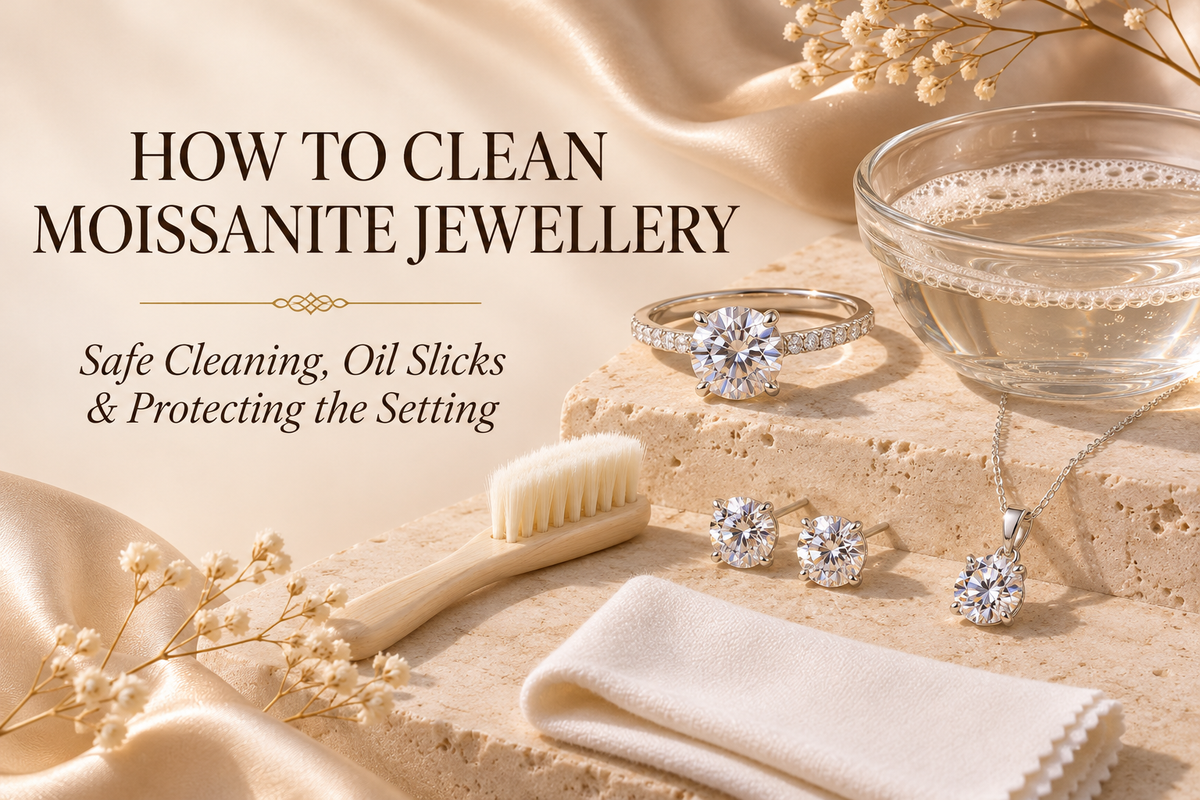
The safest way to clean most moissanite jewellery at home is surprisingly simple: warm water, a small amount of mild washing-up liquid and a very soft brush.
The moissanite itself is exceptionally durable. The setting around it is where you need to be more careful.
Prongs can loosen. Gold or rhodium plating can wear. Other gemstones in the same piece may be much more sensitive than moissanite. And an ultrasonic cleaner that is perfectly acceptable for a loose moissanite may be completely wrong for the finished jewellery.
So the first rule of moissanite cleaning is:
Clean for the most delicate part of the jewellery, not the hardest stone in it.
The Safest At-Home Cleaning Method
For ordinary dirt, skin oils, soap residue and cosmetics, start with the least aggressive method.
- Inspect the jewellery first. Check the prongs, claws and stones. If anything moves, looks bent or seems loose, stop and have the piece inspected before cleaning.
- Prepare warm soapy water. Use comfortably warm water with a small amount of mild, non-abrasive washing-up liquid. Avoid boiling or very hot water.
- Let the jewellery soak briefly. A short soak helps soften oils and residue trapped around the setting.
- Brush gently. Use a very soft toothbrush or jewellery brush around the moissanite, setting and accessible underside of the stone.
- Rinse thoroughly and dry. Rinse carefully in clean water and pat dry with a soft, lint-free cloth.
One useful precaution is to rinse jewellery in a bowl or glass rather than directly over an open sink. A loose stone or small earring is much easier to recover from a bowl than a drain.
Do Not Forget the Underside of the Moissanite
If your moissanite suddenly looks dull, the top of the stone may not be the problem.
Rings in particular collect hand cream, soap, skin oils and grime underneath the centre stone. That residue blocks light from travelling through the gemstone effectively and can dramatically reduce its brilliance.
Where the setting allows access, gently brush:
- behind the stone;
- between the prongs;
- inside the gallery beneath a ring;
- around pavé or halo settings; and
- along the back of earrings and pendants.
Do not force a brush into delicate areas or bend claws to reach underneath them.
If the stone remains hazy after normal cleaning, our guide to cloudy moissanite, dullness and oil slick explains what else may be happening.
Can You Put Moissanite in an Ultrasonic Cleaner?
Moissanite itself is generally suitable for ultrasonic cleaning.
That does not mean every piece of moissanite jewellery belongs in an ultrasonic machine.
Ultrasonic cleaners use high-frequency vibration in liquid to dislodge dirt from tiny spaces. That makes them extremely effective around complex settings.
It also creates two potential problems.
First, vibration can worsen an existing setting problem. A stone that is already slightly loose may become noticeably looser.
Second, the jewellery may contain another material that should never be ultrasonically cleaned.
For that reason, we would not make a home ultrasonic cleaner the default method for routine moissanite care.
Warm soapy water is slower and less exciting, but it carries far fewer unknowns.
The Mixed-Gemstone Rule
This is particularly important if your moissanite jewellery contains coloured gemstones.
Never decide that an ultrasonic cleaner is safe simply because the moissanite can tolerate it.
Gemstones that commonly require greater caution include:
- opal;
- pearls;
- emerald;
- tanzanite;
- moonstone;
- turquoise;
- topaz;
- zircon;
- lapis lazuli; and
- other porous, fracture-filled, coated or heavily included stones.
Emerald is a particularly good example. Many emeralds contain surface-reaching fractures that have been filled with oil or resin. Ultrasonic vibration and heat can affect both the fractures and their treatment.
Opal and pearl present completely different vulnerabilities again.
If a piece combines moissanite with another gemstone, use the cleaning method suitable for the more delicate material.
Our gemstone durability guide explains why hardness alone does not determine how a gemstone should be treated.
Be Extra Careful With Plated Settings
A gemstone can be extremely hard while the decorative finish around it is comparatively easy to wear away.
Gold-plated, rhodium-plated and other surface-finished jewellery should therefore be cleaned gently.
Avoid aggressive polishing, abrasive cleaners and unnecessary scrubbing of the metal.
This becomes especially important when dealing with a stubborn moissanite oil slick.
Some specialist products designed to remove surface film from moissanite are mildly abrasive or polishing in nature. They may be appropriate for the gemstone while being completely inappropriate for the surrounding plated metal.
Charles & Colvard specifically warns that its oil-slick cleaning cloth should be used on the stone rather than the setting because it can strip rhodium plating.
That is a useful principle beyond one particular product:
“Safe for moissanite” does not automatically mean “safe for the setting”.
What About the Moissanite Oil Slick?
The so-called oil slick is a persistent blue, brown or rainbow-like surface film that can occasionally develop on moissanite.
It is not the gemstone permanently becoming cloudy.
Start with normal warm-soapy-water cleaning.
If the film remains, do not immediately escalate to toothpaste, abrasive powders or whatever cleaning hack happens to be circulating online.
A specialist moissanite cleaning cloth may remove stubborn film when used correctly on the gemstone itself.
If the stone sits in plated jewellery or alongside sensitive gemstones, professional cleaning is the safer option before using stronger polishing products.
What Should You Not Use to Clean Moissanite Jewellery?
The internet contains plenty of cleaning methods that solve one problem by creating another.
For routine home cleaning, we would avoid:
- toothpaste — abrasive particles can scratch and dull metal finishes;
- baking soda or abrasive powders — again, the setting is usually more vulnerable than the moissanite;
- chlorine bleach — it can damage jewellery alloys;
- household cleaning chemicals — formulations are not designed around jewellery materials;
- hard-bristled brushes — unnecessary and potentially damaging to finishes and settings;
- boiling water — especially dangerous when other gemstones, treatments or adhesives are present;
- aggressive metal polish across the entire piece — particularly on plated jewellery; and
- steam or ultrasonic cleaning without knowing every material in the jewellery.
More chemical strength does not equal more cleanliness.
When Should You Let a Jeweller Clean It?
Professional cleaning makes sense when:
- the stone remains dull after gentle cleaning;
- a stubborn oil slick will not lift;
- the jewellery contains delicate or treated gemstones;
- you are unsure whether the metal is plated;
- the setting contains many tiny pavé stones;
- a prong looks worn, bent or uneven;
- the stone moves when touched; or
- the jewellery has not been professionally inspected for a long time.
A competent jeweller can inspect the setting before choosing an ultrasonic, steam or other cleaning process.
That inspection matters. Making a stone brilliantly clean is not useful if the cleaning process exposes a setting that was already close to losing it.
How Often Should You Clean Moissanite Jewellery?
There is no useful universal calendar.
Clean it when buildup starts affecting the appearance.
A ring worn daily and exposed constantly to hand cream may need attention much more often than earrings worn once a week.
A quick wipe with a clean lint-free cloth after wearing can also reduce the amount of oil and cosmetic residue that accumulates.
The goal is not constant aggressive cleaning.
It is preventing heavy buildup in the first place.
Keep the Method Simple
Moissanite does not need harsh treatment to stay brilliant.
For most ordinary cleaning, warm water, mild soap and a soft brush are enough.
Before using anything stronger, think about the jewellery as a whole:
the stone, the prongs, the plating, any additional gemstones and any treatments.
Moissanite may be the toughest part of the piece.
Cleaning according to that toughest component is exactly how damage happens.
Clean for the most vulnerable material in the jewellery, and you are far less likely to turn routine maintenance into a repair.
To explore moissanite across different jewellery types, browse our moissanite jewellery collection, including rings, earrings, necklaces and bracelets.
Discover Moissanite Rings
Explore solitaire, halo, trilogy, side-stone and more distinctive moissanite ring styles designed for jewellery that becomes part of everyday life.



Conversation